Under the FDA Model Food Code, ice isn’t a garnish, a convenience, or an afterthought. It’s legally classified as a food product. The same category as the chicken in your walk-in, the produce on your prep line, the dairy in your reach-in. And yet most operators treat the machine making it like a vending appliance instead of what it actually is: a piece of food production equipment that happens to make something cold and clear.
That’s the problem. Nobody walks into a bar and asks to see the ice machine. Except the Health Department Inspectors.
You’ll polish the bar top, frame the liquor license, sweat over the playlist, and twelve feet away, in a stainless box nobody opens unless it breaks, you’re running a humid, dark, 34-degree breeding ground that mold treats like a beachfront condo. Ice machine cleaning isn’t glamorous. It’s also the difference between serving a drink and serving a science experiment and legally, it’s the difference between food safety and a food safety violation.
Let’s talk about what’s actually growing in there, why it’s quietly destroying your machine from the inside, why the Health Department treats it as seriously as raw chicken left out on the counter, and why “every six months” is a floor, not a finish line.
The Slime Nobody Wants to Talk About
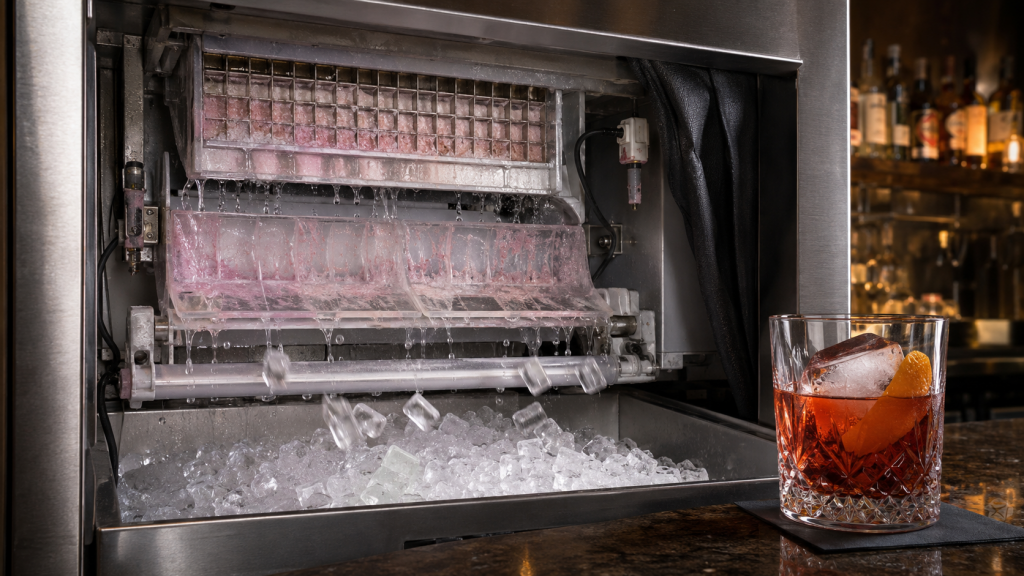
Pull the curtain off a neglected ice machine and you’ll meet pink slime mold — Penicillium, usually, sometimes black mold, sometimes a biofilm so established it’s basically got tenure. It’s not theoretical. It’s not “might happen.” Warm, wet, dark, sugar-and-mineral-rich environments are exactly what fungi and bacteria evolved to colonize, and your ice machine checks every box.
This stuff doesn’t politely sit in the bin waiting to be discovered. It rides on the water. It coats the evaporator plate. It clogs the water curtain and the little sensors that tell the machine how much ice it’s made. And then it ends up in a rocks glass, sitting on top of a $16 Negroni, dissolving into someone’s drink while they have absolutely no idea what they just swallowed.
That’s the gross part. Here’s the expensive part.
Mold Doesn’t Just Sit There, It Eats Your Machine
This is where most operators get it wrong. They think a dirty ice machine is a hygiene issue. It’s also a mechanical failure waiting to happen, and the damage is often permanent.
- Float switches and water sensors get coated in biofilm and start misreading water levels — leading to overfills, underfills, or a machine that just gives up.
- Scale and mineral buildup team up with bacterial slime to corrode and pit components that were never designed to be marinated in funk.
- Evaporator plates caked in scale can’t transfer cold efficiently, so the compressor works harder to compensate — and compressors are not a “wipe it down and it’s fine” repair. That’s a several-thousand-dollar replacement.
- Drain lines clog with biofilm, water backs up, and now you’ve got corrosion in places you can’t see until the machine just… stops.
None of that reverses with a good scrub once it’s gone too far. You’re not cleaning your way out of a fried sensor or a seized compressor. Preventive maintenance is the entire game — once the damage is mechanical, you’re buying parts, not buying cleaner.
Six Months Is the Floor, Not the Finish Line
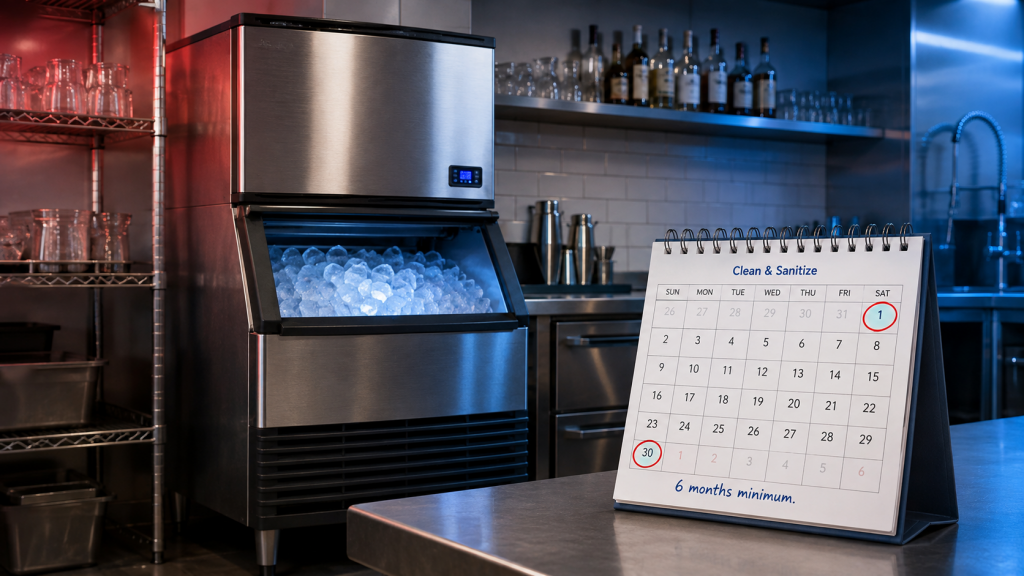
Here’s the honest answer, the one most “how often should I clean my ice machine” articles dance around: every machine should get a full clean and sanitize at least every six months. No exceptions, no skipping a cycle because business was slow.
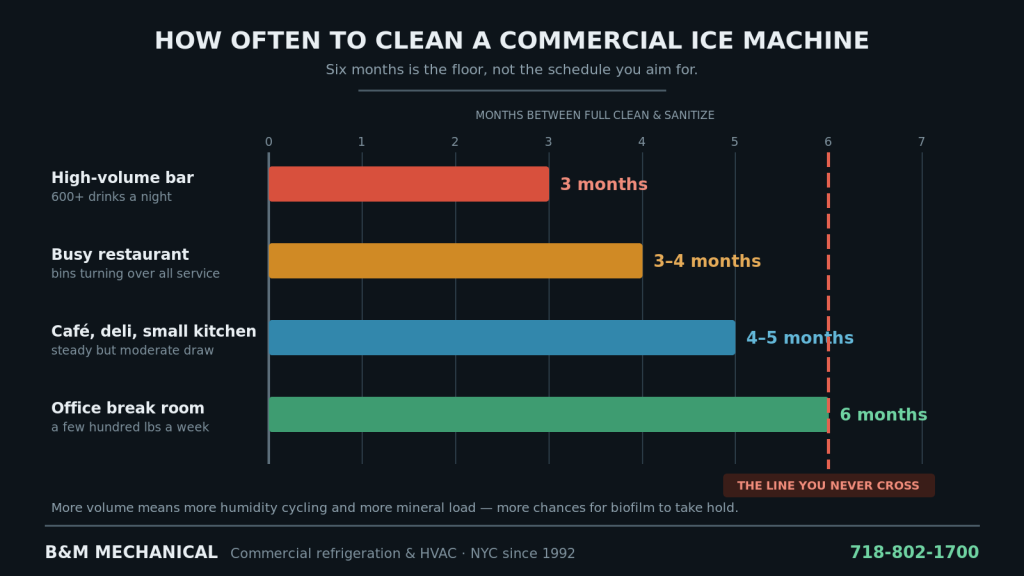
But six months is the minimum for a low-volume office break room machine making a few hundred pounds a week. If you’re a bar doing 800 drinks on a Saturday night, or a restaurant running through bins constantly during a heat wave, you need to be looking at every 3-4 months — because volume means more humidity cycling, more mineral load, and more opportunities for biofilm to set up shop. Manufacturer specs (Manitowoc, Hoshizaki, and most major commercial units) generally recommend the 3-4 month range for high-use commercial environments. Treat six months as the line you never cross, not the schedule you aim for.
The Health Department Doesn’t Care About Your Cocktail Menu
Here’s who actually cares whether your ice machine is clean: the NYC Department of Health, and they care a lot more than your customers do because your customers can’t see inside the machine, and the inspector can.
Under NYC Health Code, ice that isn’t potable isn’t a footnote, it’s a critical violation. Not a warning, not a note on a clipboard. Critical, the same category as the stuff that gets a restaurant’s grade dragged down in front of God and Yelp. You’re allowed 13 points total to hang onto your A. A single ice machine citation can run you 5 points and a fine in one shot. Do the math on how many “minor” issues you can afford to stack on top of that before you’re staring at a B in your front window.
And it gets worse before it gets better: inspectors don’t just glance at the ice. They’ve started showing up with screwdrivers specifically to pull the paneling off ice machines and check what’s growing behind it. That’s not a rumor, that’s standard equipment now. The inspection isn’t “is the ice clean.” It’s “what does the inside of this machine actually look like when nobody’s supposed to be looking.”
Stack enough critical violations, or get hit with something the city calls an imminent health hazard, and you’re not talking about a worse letter grade anymore. You’re talking about a closure — the kind where the door gets a sign on it instead of a grade. That’s the ceiling, not the typical outcome, but it’s a real outcome, and it starts in the same neglected ice bin nobody wanted to open.
The kicker: the A in your window isn’t just a grade. It’s free advertising you paid for by doing nothing extra. Just maintenance you should’ve been doing anyway. Let it slip, and you’re not just risking a fine. You’re putting a public, dated, time-stamped admission of neglect right at eye level for every person walking past your door.
It’s Not Just Restaurants! Everybody’s Guilty
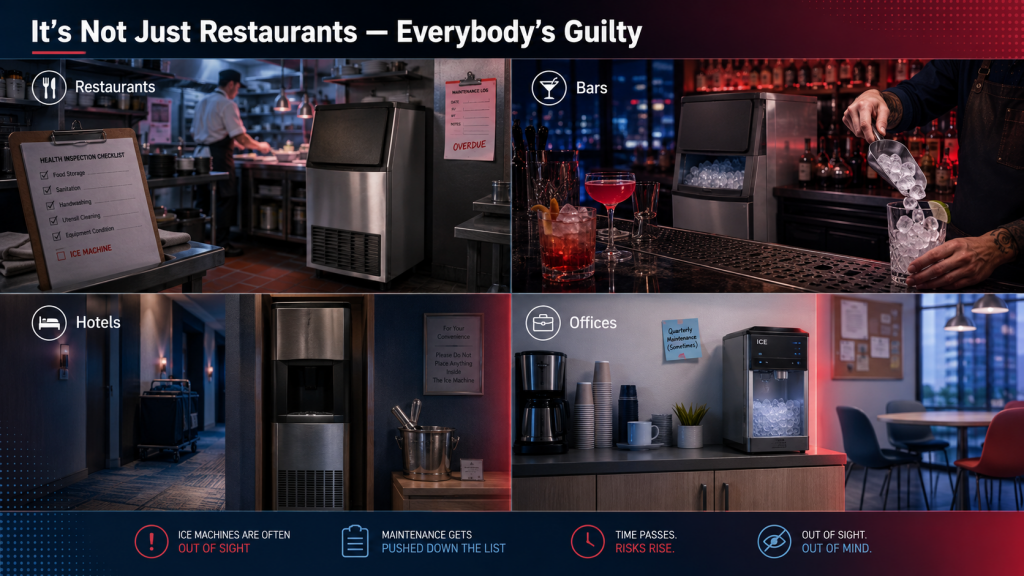
Restaurants
This is the obvious one health code, customer-facing, your name on the Yelp review when someone gets sick. Restaurant ice machine cleaning isn’t optional; it’s a line item in every health inspection, and ice is legally treated as a food product in most jurisdictions. Yes — food. Most kitchens that would never let a cutting board go six months without a deep clean somehow forget the ice machine sitting fifteen feet away.
Bars
Bars have the dirtiest secret in the industry: ice goes directly into the product, with zero cooking step to kill anything. A pristine craft cocktail program built on a filthy ice well is a contradiction nobody’s pricing into the cost of the drink. Bar ice machine maintenance matters more here than almost anywhere else, because there’s no heat, no dilution, no forgiveness. Just ice, straight into the glass, straight into the customer.
Hotels
Hotel ice machines are the ones nobody thinks about because they’re tucked in a hallway nook, making ice for guests who’ll never see the inside of that machine and have no idea what they’re scooping into a bucket at 11pm. High guest turnover means high usage and minimal scrutiny. A bad combination. Commercial ice machine maintenance for hotels isn’t a back-of-house afterthought; it’s a guest-facing risk hiding behind a vending machine.
Offices
Yes, even your break room. Office ice machines often get worse neglect than commercial kitchens because there’s no health inspector walking through, no manager whose job depends on it, and “someone will deal with it eventually” becomes the unofficial maintenance plan. Lower volume doesn’t mean lower risk. It often means longer stretches of stagnant water sitting exactly where mold wants it. Office ice machine cleaning schedule should still hit that six-month floor, no matter how few people are using it.
What You CAN Clean (And What You Shouldn’t Touch Yourself)
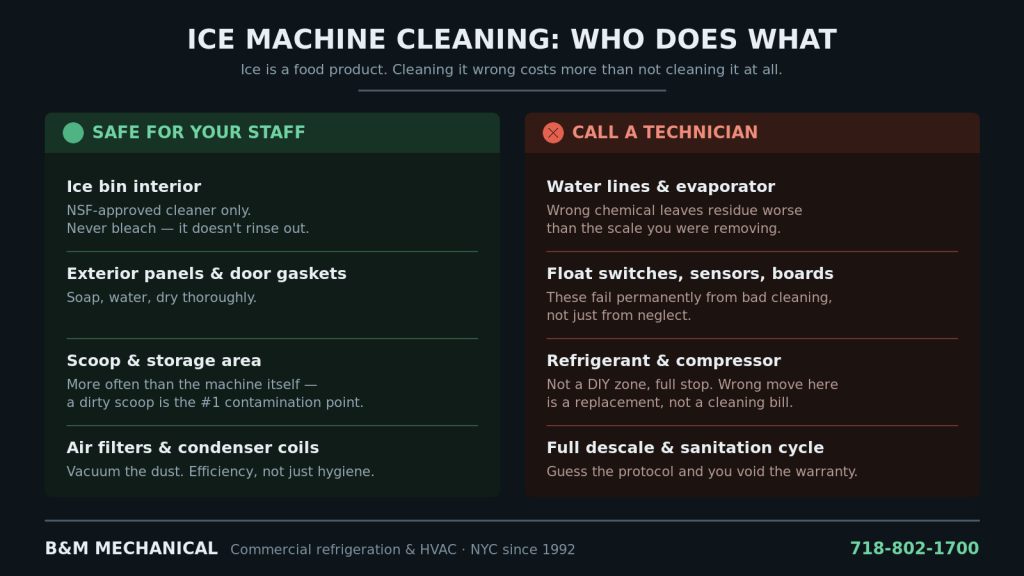
Safe to clean yourself, on a routine basis:
- Ice bin interior — wipe down with a food-safe, NSF-approved ice machine cleaner. Never use bleach near food-contact surfaces; it doesn’t fully rinse and leaves residue.
- Exterior panels and door gaskets — basic soap and water, dry thoroughly.
- Scoop and storage area — should be cleaned more often than the machine itself. A dirty scoop left sitting in the bin is one of the most common contamination points in the entire operation.
- Air filters/condenser coils on air-cooled units — vacuum or brush off dust buildup; this affects efficiency, not just hygiene.
Leave it to a professional technician:
- Internal water lines and the evaporator assembly — descaling chemicals used incorrectly can damage components or leave residue that’s worse than the scale itself.
- Float switches, water sensors, and control boards — these are the exact parts that fail permanently from improper cleaning, not just neglect. Aggressive scrubbing or the wrong chemical can short out what neglect alone hadn’t killed yet.
- Refrigerant lines and compressor components — this isn’t a DIY zone, full stop. Wrong move here and you’re not looking at a cleaning bill, you’re looking at a replacement.
- Full descale and sanitation cycles — most commercial units have a specific cleaning protocol (and chemical) the manufacturer requires to keep the warranty valid. Guess wrong and you may void coverage on a machine that just failed.
The Bottom Line
Ice is food. Not “basically food,” not “food-adjacent,” it’s legally, literally food, sitting in the same regulatory category as the chicken in your walk-in. The Health Department already knows that. The screwdriver in the inspector’s pocket already knows that. The only question is whether you’re going to know it before the inspection, or find out after your A is gone.
Nobody’s putting “I clean my ice machine on schedule” on their menu. It’s invisible work, until it isn’t, and then it’s either a critical violation chipping away at the 13 points standing between you and a worse grade, a compressor replacement, or a customer who got sick off a drink they ordered to feel good.
Maintenance isn’t the sexy part of running a restaurant, bar, hotel, or office. But the operators who treat their ice machine like the food production equipment it legally is. Not the thing you forget until it breaks are the ones who aren’t explaining to a health inspector, a GM, or an HR department why the grade just dropped or the machine just failed during the worst possible week.
Clean the machine. Trust the technician with the parts that matter. And maybe don’t think too hard about the last rocks glass you didn’t ask questions about.